ASTM A753 Alloy 4 (MIL-N-14411C Composition 1): What It Is and How Apollo MFG Can Help
Share
Engineers and buyers responsible for magnetic shielding components frequently encounter a material callout of ASTM A753 Alloy 4 or MIL-N-14411C Composition 1. These parts are typically thin, geometrically detailed and schedule-critical. They must be cut accurately, and they must deliver the specified shielding performance once installed. This article explains what the specification requires, identifies the process step that determines whether a part conforms, and outlines how Apollo MFG supports these programs.
What Is ASTM A753 Alloy 4?
ASTM A753 is the standard specification for wrought nickel-iron soft magnetic alloys and covers four alloy types. Alloy 4 (UNS N14080) is the high-nickel grade, with a chemistry of 79 to 82 percent nickel, 3.5 to 6 percent molybdenum and the balance iron, together with strict limits on carbon, sulfur and other residual elements.
The alloy is commonly referred to as mu-metal and is also supplied under trade names such as HyMu 80, Permalloy 80 and MuMETAL. MIL-N-14411C Composition 1 is the corresponding military specification for this 80 percent nickel alloy family, and many material suppliers certify to both documents. Drawings that reference SAE AMS7701 Type 2 refer to the same material; that specification was cancelled in 2010 and superseded by ASTM A753 Alloy 4.
Typical Applications
Alloy 4 offers very high magnetic permeability. It provides a low-reluctance path that diverts static and low-frequency magnetic fields around the components enclosed by the shield. Performance is greatest from DC into the low kilohertz range. Typical applications include:
- Sensors, current transformers and precision instrumentation
- Medical imaging and laboratory equipment
- Aerospace and defense electronics
- Transformer and power-supply shielding
- Photomultiplier tubes and other electron-beam devices
Alloy 4 is not intended for radio-frequency shielding. Higher-frequency fields are addressed with high-conductivity materials such as copper and aluminum.
The Critical Process Step: Final Hydrogen Annealing
Alloy 4 is generally supplied in a stress-annealed condition to permit cutting and forming. Each cutting, forming, punching or welding operation introduces residual stress and significantly reduces permeability. The specified magnetic properties are developed only through a final heat treatment in a dry hydrogen atmosphere.
Published practice for this alloy calls for a soak at approximately 2050 to 2150 °F (1120 to 1180 °C) for 2 to 6 hours in dry hydrogen, followed by a controlled cooling cycle. ASTM A753 notes that close adherence to the prescribed cooling rate is particularly important for this alloy. Two requirements follow:
- The final anneal must be performed after all cutting, forming, welding and drilling operations.
- Annealed parts must be handled with care. Bending, dropping or denting a finished shield degrades its magnetic performance.
A cut blank is therefore an intermediate product. Conformance to ASTM A753 Alloy 4 is achieved only after the final anneal has been completed and documented.
The Role of Laser Cutting
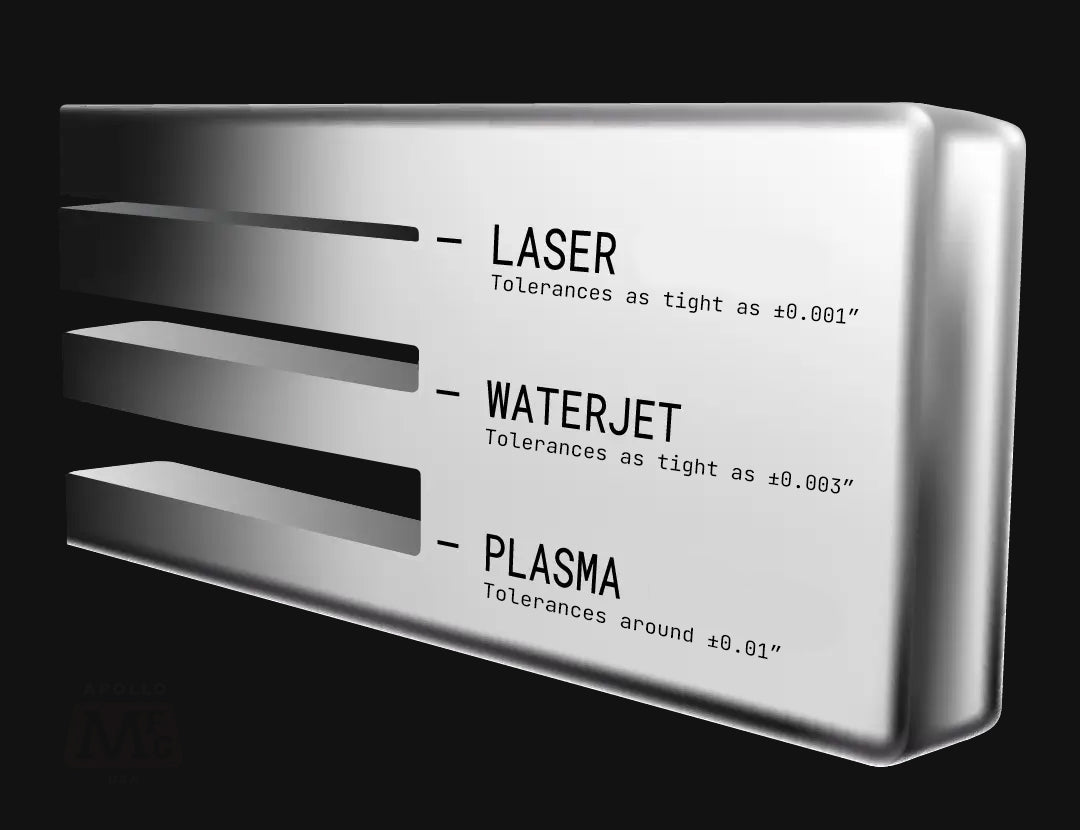
Fiber laser cutting is well suited to thin nickel-alloy sheet. It produces detailed profiles, small holes and narrow slots with minimal kerf and without hard tooling, which supports both prototype and short-run production. As with any cutting method, the process introduces stress along the cut edge. Because the final hydrogen anneal follows all fabrication, this stress is relieved during heat treatment, which further underscores that the anneal cannot be omitted.
How Apollo MFG Supports Your Program
Apollo MFG laser cuts ASTM A753 Alloy 4 / MIL-N-14411C Composition 1 sheet to customer drawings at our facility in Fort Wayne, Indiana. Final hydrogen annealing is performed by a qualified outside heat-treat partner; Apollo MFG coordinates this process on your behalf. The process is as follows:
- Submit your drawing and specification, including the material callout, thickness, quantity and any annealing or certification requirements.
- Apollo MFG laser cuts the parts to drawing, then deburrs, cleans and packages them for heat treatment.
- Apollo MFG coordinates the final hydrogen anneal with a qualified outside heat-treat partner, or ships to your approved heat treater if you have one.
- You receive finished parts with the documentation your order requires, such as material certifications and the heat-treat certification.
Parts are identified as meeting ASTM A753 Alloy 4 only after the final anneal has been completed and documented.
Drawing and Order Recommendations
- Specify both the standard and the UNS number (N14080). Alloy 2 within the same standard is a different, lower-nickel alloy.
- Identify any forming or welding required after cutting, since all such operations must precede the anneal.
- Identify any attached hardware. It must be installed before annealing and must withstand the annealing temperature.
- Define packaging requirements for annealed parts to prevent bending or denting in transit.
Request a Quote
For shielding components that call out ASTM A753 Alloy 4 or MIL-N-14411C Composition 1, submit your drawing to Apollo MFG. Our team will review the cutting requirements, the annealing route and the documentation needed, and will provide a clear statement of scope.
Contact Apollo MFG: apollomfg.com/pages/contact | sales@apollomfg.com | (260) 497-9191 | 4012 Merchant Rd., Fort Wayne, IN 46818
We mark to the spec. Verification reports on request.